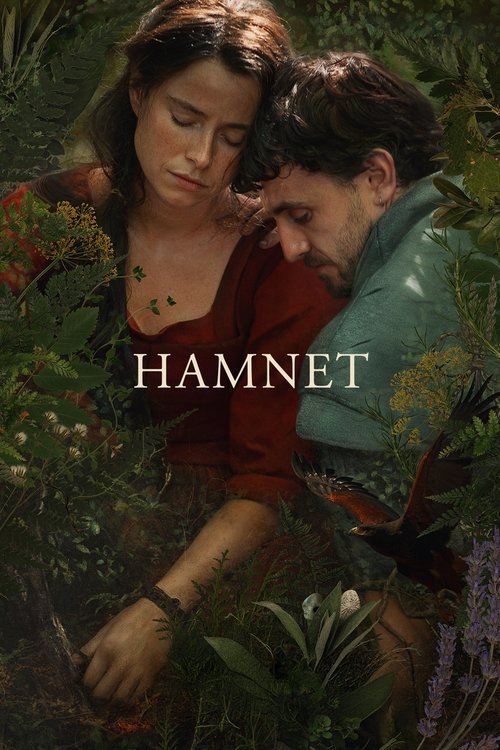





















Popular
What role does Agnes play in the film Hamnet and how is her character portrayed?
How is William Shakespeare depicted in the movie Hamnet?
What specific events lead to the tragedy of Hamnet's death in the film?
How does the film Hamnet visually and atmospherically represent the Elizabethan era?
What is the significance of the twins, Hamnet and Judith, in the story?
Should I watch it?
Ask Your Own Question

What is the plot?
A title card explains that in late sixteenth-century Stratford-upon-Avon the names "Hamnet" and "Hamlet" are used interchangeably. The film opens with a sequence in the woods: Agnes Hathaway walks along a dappled path toward a cave mouth, wearing a red dress and carrying a falconry glove. She calls a hawk and the bird settles on her wrist. Nearby, William Shakespeare pauses his Latin tutoring and crosses a field to the barn to greet her. He approaches the hawk, which nips his finger; Agnes smiles and tells him the bite is a sign of favor. William asks her name, they talk, and they share a first kiss before he returns to his pupils.
Agnes gathers herbs in the forest and tends the hawk; she has learned plant lore from her mother, Rowan, who died when Agnes is still young. In the village people whisper that Agnes is the daughter of a forest witch, but she uses her knowledge to make salves and to read palms. When William comes again to the woods he asks her to tell him a story. He narrates the myth of Orpheus and Eurydice, and Agnes listens, laughing and gripping his hand. She looks at his palm and speaks of a future in which his name will be celebrated; she tells him she imagines dying with two children. They become lovers and a pregnancy follows.
Agnes's pregnancy becomes known, and her father's household turns against her. Her stepmother Joan and other relatives treat her with suspicion and shame; Bartholomew, her half-brother, stands by her. William brings Agnes to the Shakespeares' home to be married. The marriage is hurried and awkward in the family house: Mary Shakespeare, William's mother, and John, his father, disapprove. John calls William idle and worthless; in one volatile scene John strikes his son twice as he berates him for refusing manual labor. William reaches a breaking point, shoving his father against a wall and telling him he will no longer accept the abuse, then leaves to pursue writing and the theater while still doing occasional work for his father.
Agnes goes into labor in the woods and gives birth to her first child, Susanna. William and Bartholomew find them in the trees and confirm mother and baby are well. Agnes raises Susanna in the house she shares with the Shakespeares, and months later she again becomes pregnant. On the mandated night of the twins' birth, Mary and other family members keep Agnes indoors, fearful of superstition that a woman must not be outside at childbirth. Agnes resists but is restrained; she endures a painful labor. She delivers a son, Hamnet, and then a girl who appears stillborn. Agnes insists on holding the infant, refusing the idea that the child is condemned by fate; as she speaks to her, the baby Judith stirs and breathes. Agnes remembers the fear and grief of watching her own mother die and resents the family's attempts to control the birth.
Time passes. William's writing begins to take him away to London and its acting companies. He leaves to immerse himself in the theatrical world, returning periodically to Stratford. His success grows unevenly; he drinks heavily at times and wakes the household with late-night frustrations. The children, now eleven, grow close: Hamnet and Judith play tricks on their parents by swapping garments and confusing servants; they perform scenes from plays, imitating witches and sword fights, and Will sometimes teaches them lines. Agnes watches them with a mixture of tenderness and foreknowledge; she tells Hamnet she believes he will thrive and that he has an appetite for the stage.
The family buries Agnes's hawk after it dies. In a small cemetery ceremony Agnes wraps the bird and places it into the earth, telling the children that the hawk carries wishes in its heart and that if they look closely they can see its spirit in the air. A song about a bird's journey recurs in the household and in Hamnet's private imaginings. William purchases a larger house for the family in Stratford, an act that outwardly marks his financial progress even as his absences lengthen.
In London, William's life is more volatile: crowds gather along the Thames to watch puppet shows and street performers. One puppet drama depicts the plague as a gaunt figure carrying off victims in a macabre parade; William watches the images of corpses and hears gossip about bubs and contagion. He rehearses with actors who often challenge him, and in one scene at the riverbank he mutters lines of a new play aloud to himself, pacing and confronting the emptiness of the water and the question "to be or not to be" in muted tones.
Back in Stratford, sickness arrives. Judith falls ill with fever and sores. Hamnet returns from school and discovers his sister burning with disease. He lies beside her bed and tells the illness to take him instead; he wraps his small body to make room for her and whispers that he will trade places. Agnes tends to Judith with poultices and herbs she learned from Rowan; she speaks Old English charms and binds the child in cloth. Judith recovers slowly and opens her eyes, while Hamnet, who seemed healthy at first, begins to weaken. His fever climbs; he has violent stomach cramps and coughing fits. During his worst moments he slips into visions: he sees himself in an empty, echoing house and cries out for his mother. He imagines the hawk lifting him and feels the world recede. He trembles on the bed, crying for Agnes by name, and then convulses. Agnes holds him and sings to him as he goes into agonized fits; his body cools and slackens. He dies in Agnes's arms, quieting into stillness after a night of writhing pain.
Agnes screams and wails at Hamnet's passing. She pounds the floor and calls for help, while Susanna and Judith gather at the bed to look at their brother's motionless face. When William returns from London to the Stratford house he moves slowly into the bedroom and pauses at the doorway. Seeing Hamnet's lifeless body he can only say in a hollow voice, "That's my boy," before collapsing or crumpling with grief. Agnes blames herself aloud for not protecting her child despite the remedies she used; she says she cannot see the future anymore, that the visions have gone. William, frantic and bruised by his own repressed lamentations, declares there was nothing they could have done; he announces he must return to London and his company. Agnes reacts with fury to his decision, accusing him of abandoning home and family.
After the twin's death, William throws himself into his work in the city. He quarrels with an actor who refuses to bring force to a scene; he tells the player that the words need truth and that the audience deserves to be moved. In London he rehearses a new tragedy, The Tragedie of Hamlet, and he casts an actor to play the prince and himself to appear as the ghost of Hamlet's father. In one rehearsal near the river he demands a grimmer intensity from the performers and scolds a lead for slackness; he sits by the Thames, hands clasped, and lets the water darken his thoughts.
News of the play and its opening reaches Stratford. Joan shows Agnes a printed playbill advertising William's production and ridicules Agnes for marrying his son. Agnes, still hollowed by grief, decides to travel to London with Bartholomew to see the show; she wants to witness whether the boy's name is being used in jest or tribute. She and Bartholomew stand among a crowded audience for the performance at the wooden playhouse. At first Agnes tenses, angry that a name she holds dear is being turned into spectacle. During the early scenes she bursts out, coughing and interrupting, convinced it denigrates Hamnet's memory.
As the play proceeds the portrayal shifts Agnes's attitude. She watches William appear on stage as the ghost of Hamlet's father; he moves with a manner that feels intimate and raw, and he infuses the part with a father's grief. The lead actor playing Hamlet embodies the young prince with a physicality that recalls the boy Agnes lost--he fights with a sword, paces near the stage edge, and delivers lines full of yearning. Agnes remembers Hamnet's own desire for swordplay and stagecraft; she sees the actor enact gestures she once taught her son. The scene in which Hamlet speaks with his father's ghost arrests the house: William's presence onstage and the actor's response combine into an intensity that loosens Agnes's anger.
Backstage William watches as Agnes watches; he hears her sobs from the wings. At several points he falters in performance, stares at the boards, and recovers. The swordfight sequences that follow mirror the child's earlier playacting and Hamnet's daydreams. During Hamlet's dying moments the audience leans forward; the actor playing Hamlet collapses near the footlights and speaks his final lines. Agnes reaches out with both hands as though to touch the actor's fingers; others in the crowd stretch their hands too. In that instant she sees, in her mind's eye, a small boy standing on the stage: the Hamnet she lost steps forward, his face moving from sorrow to a soft smile. He takes a step backward and slips through an opening toward the backstage--a hole that resembles the cave mouth in the woods where Agnes once called the hawk. The vision lasts only moments; the boy tilts his head toward her and then vanishes out of sight.
Agnes's reaction shifts from grief to a sudden, quiet exhale; a laugh slips out of her and then a small smile forms, the first she allows herself since Hamnet's death. The rest of the auditorium reels with emotion as the play concludes. William, leaving the stage, meets Agnes offstage for a brief, wordless exchange. She rests her hand on his chest and nods; he presses his forehead to hers. They stand in the wings while the players take their bows and the crowd disperses into the London night.
The film closes with Agnes walking away from the Globe, Bartholomew beside her, and an image of Hamnet moving through a backstage passage that echoes the forest cave. In the final shots Agnes breathes in and allows a small laugh to escape as she watches performers carry props past her. The camera lingers on her expression changing from bereaved to a fragile acceptance, then cuts to black. The credits roll after a last view of the empty stage where the play ended, leaving the house dark but not quite silent.






What is the ending?
The movie Hamnet (2025) ends with the profound grief of Agnes and William Shakespeare following the death of their 11-year-old son, Hamnet. Agnes is left to raise their remaining children alone, while William buries himself in his work, channeling his sorrow into his plays. The film closes on a somber yet intimate note, emphasizing the enduring impact of loss on their family and creative lives.
Expanded narrative of the ending scene by scene:
The final act of Hamnet unfolds in the Shakespeare household after the devastating loss of Hamnet to the plague. Agnes, portrayed by Jessie Buckley, is shown grappling with overwhelming grief. The camera lingers on her solitary moments--her face etched with sorrow as she tends to the household and her two daughters, Susanna and Judith. The scenes emphasize her isolation and the heavy burden of raising the children without her son and with William increasingly distant.
William Shakespeare, played by Paul Mescal, is depicted in his study, consumed by his writing. His demeanor is withdrawn, and he channels his pain into his plays, a creative refuge from his personal tragedy. The film shows him struggling to connect emotionally with Agnes, highlighting the strain the loss has placed on their marriage.
A key scene shows Agnes and William in a quiet, tense exchange, where their shared grief is palpable but unspoken. Agnes's eyes reveal a mixture of love, pain, and resignation, while William's focus remains on his work, symbolizing their different ways of coping.
The film then shifts to a poignant moment where Agnes watches her children play, a bittersweet reminder of what was lost and what remains. The naturalistic cinematography captures the rural English setting with dew on the grass and soft light, underscoring the fragile beauty of life amid sorrow.
In the closing scenes, Agnes is seen writing a letter or perhaps reflecting silently, suggesting her attempt to find meaning or peace. William's final moments on screen show him finishing a manuscript, hinting at the birth of Hamlet, the play inspired by their son's death.
The fate of the main characters at the end is clear: Hamnet has died, Agnes remains a grieving mother and caretaker, and William is a grieving father and playwright whose art is forever marked by this loss. The film ends without resolution of their grief but with a quiet acknowledgment of its transformative power on their lives and legacy.
Who dies?
In the movie "Hamnet," produced in 2025, the narrative centers around the tragic life of the young boy Hamnet, the son of William Shakespeare and his wife, Anne Hathaway. The film poignantly explores themes of grief, loss, and the impact of death on a family.
The primary character who dies in the film is Hamnet himself. His death occurs in the late summer of 1596, when he is just eleven years old. The circumstances surrounding his death are deeply intertwined with the themes of illness and the fragility of life during that period. The film depicts a devastating outbreak of the bubonic plague that sweeps through Stratford-upon-Avon, claiming many lives, including that of Hamnet.
As the story unfolds, Hamnet falls ill, and the film captures the emotional turmoil of his family as they grapple with the uncertainty of his condition. His mother, Anne, is portrayed as a fiercely protective and loving figure, desperately trying to care for her son while battling her own fears and helplessness. The scenes are filled with tension as the family watches Hamnet's health decline, showcasing the intimate moments of love and despair shared between mother and son.
Hamnet's death is depicted with a haunting beauty, emphasizing the profound sorrow that envelops the family. The moment is marked by a quiet stillness, as Anne holds her son in her arms, tears streaming down her face, while the world outside continues unaware of their tragedy. The film captures the raw emotions of loss, portraying Anne's heart-wrenching grief and William's deep sense of helplessness as he is away in London, unable to be by his son's side.
The impact of Hamnet's death reverberates throughout the film, influencing William Shakespeare's later works and his exploration of themes of mortality and loss. The film concludes with a poignant reflection on how the death of Hamnet shapes the family's legacy, leaving an indelible mark on both Anne and William as they navigate their grief in the years that follow.
Is there a post-credit scene?
The movie Hamnet (2025) does not have a post-credits scene. Reviews and coverage of the film, including detailed critiques and festival screenings, do not mention any additional scenes after the credits, and no sources indicate the presence of a post-credit or mid-credit scene for this film.
Hamnet is a historical drama directed by Chloé Zhao, focusing on the emotional impact of the death of Shakespeare's son Hamnet on his family. The film's ending is noted for its powerful and haunting conclusion, leaving audiences deeply moved, but it concludes without extra scenes after the credits.
What role does Agnes play in the film Hamnet and how is her character portrayed?
Agnes, played by Jessie Buckley, is the wife of William Shakespeare and the emotional center of the film. The story focuses on her struggle to come to terms with the loss of her only son, Hamnet. She is portrayed with visceral intensity, embodying a healer and a deeply emotional figure whose grief and resilience drive much of the narrative. Her relationship with William and her experience of motherhood are central to the film's emotional impact.
How is William Shakespeare depicted in the movie Hamnet?
William Shakespeare, portrayed by Paul Mescal, is shown more as an ordinary man and family figure rather than the iconic playwright. The film explores his ambitions as a writer and actor, his relationship with Agnes, and the impact of their son Hamnet's death on his life and work. His character is integral to the story, especially in how the tragedy influences his later creation of the play Hamlet.
What specific events lead to the tragedy of Hamnet's death in the film?
The film depicts the family living in Tudor Stratford-Upon-Avon, with the backdrop of the plague affecting the community. Hamnet, one of the twins, falls ill and dies young, which is the pivotal tragedy around which the story revolves. The film shows the emotional and familial consequences of this loss, focusing on the intimate moments of grief experienced by Agnes and William.
How does the film Hamnet visually and atmospherically represent the Elizabethan era?
Director Chloé Zhao uses a near-documentary naturalism style with ethereal images and natural light to create a tangible sense of 16th-century rural England. The landscapes and settings are depicted with a sensorial, almost fairy-tale quality, emphasizing the relationship between people and nature. This approach makes the historical period feel immediate and emotionally resonant rather than distant or purely historical.
What is the significance of the twins, Hamnet and Judith, in the story?
Hamnet and Judith are the twin children of William and Agnes Shakespeare, born in 1585. Hamnet's death is the central tragedy of the film, deeply affecting the family and inspiring Shakespeare's later work. Judith, as Hamnet's twin sister, represents the surviving child and the continuation of the family line. Their relationship and the impact of Hamnet's death on Judith and the family dynamics are important plot elements explored in the film.
Is this family friendly?
The movie Hamnet (2025) is not family friendly for young children or sensitive viewers due to its heavy and emotionally intense subject matter. It deals with the tragic death of a child and the profound grief experienced by his family, which is portrayed in a deeply moving and sometimes devastating way.
Potentially upsetting or objectionable aspects include:
- Themes of child death and family tragedy, which are central to the story and handled with emotional intensity.
- Mild violence and gore, likely related to the depiction of illness and death.
- Severe sexual content and nudity, which may be inappropriate for younger audiences.
- Mild profanity and mild use of alcohol, drugs, and smoking.
- Moderate frightening and intense scenes, reflecting the emotional and physical hardships faced by the characters.
Overall, Hamnet is a visually beautiful but emotionally shattering film that explores grief and loss in a historical setting. It is best suited for mature audiences who can handle serious and somber themes.